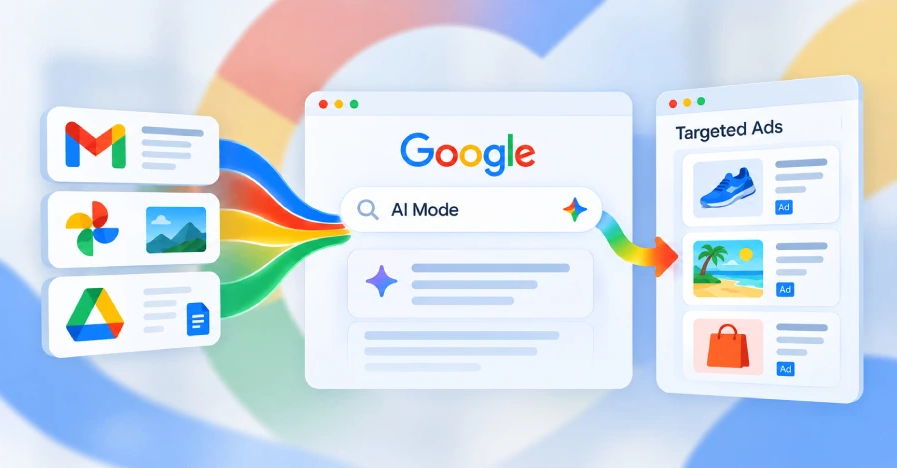
Google Privacy Policy Update Warns AI Personalization Could Influence Targeted Ads
Google has updated its privacy policy to clarify that using personalized artificial intelligence (AI) features in Search or Gemini could allow the company to serve targeted advertisements based on users' activity across connected Google services.
The policy update, effective October 16, 2026, explains that users may allow certain Google services, including Search and Gemini, to access data from other services such as Google Photos, Gmail and Google Drive to provide a more personalized experience.
"You may choose to allow certain Google services, including services like Search or Gemini Apps, to access data from other Google services you use, such as Google Photos and Workspace apps like Gmail and Drive, in order to provide you with a more personalized experience, subject to the policies and settings of the accessing service," the updated policy states.
Google adds that Search may process data users allow it to access to personalize content, including advertisements.
Google Clarifies How Personal Data May Be Used for Ads
Google's revised privacy policy emphasizes that personal content from Gmail, Drive and Google Photos is not used to personalize advertisements by default.
The company states:
"We don't show you personalized ads based on your content from Drive, Gmail, or Google Photos, unless you choose to make data from these services available to other Google services that support personalized ads."
This means users who enable integrations between Google's AI tools and other services may allow information from those services to influence personalized experiences, including advertising.
The policy update was first reported by Android Authority.
What Is Google's Personal Intelligence Feature?
Google introduced Personal Intelligence in Gemini in January 2026. The feature allows users to connect services such as Gmail, Google Photos and YouTube so Gemini can provide more tailored responses using information from those sources alongside relevant conversation context and preferences.
The feature is rolling out as a beta to eligible users over the age of 18 globally, with exceptions including the European Economic Area, Switzerland, the United Kingdom and Nigeria.
By connecting these services, users can receive more contextual answers. However, doing so also introduces privacy considerations because information shared with AI tools may be processed under the policies and settings governing those tools.
How AI Personalization Could Affect Targeted Advertising
The key distinction is whether users choose to make their personal data available to Google services that support personalized advertising.
For example, if a user enables Personal Intelligence and allows Search or AI Mode to access relevant Gmail or Google Photos content, information made available through that integration could be used to personalize content and ads where the applicable settings and policies permit it.
This does not mean every email or photo automatically becomes advertising data. Rather, Google's updated policy clarifies the potential connection between data shared with AI features and advertising personalization.
Users should understand the privacy trade-offs before connecting personal accounts to AI services.
How to Manage or Disable Personalization
Users who prefer to limit data sharing can review their connected apps and personalization settings.
Recommended steps include:
- Review which Google apps are connected to Personal Intelligence.
- Disconnect services that do not need to share information with AI features.
- Review Google's Search Services Personalization settings.
- Disable personalized recommendations where the available settings permit it.
- Review Google's Privacy Policy to understand how data is handled across services.
These steps can help users make more informed decisions about how their personal information is used.
OpenAI Also Expands Advertising on ChatGPT
Google's policy update comes amid broader changes in how AI companies approach advertising.
In January 2026, OpenAI began showing ads to logged-in adult users in the United States using the free and ChatGPT Go plans. The company emphasized that users' conversations remain private from advertisers and that customer data is not sold to them.
OpenAI has also stated that advertisements do not influence the chatbot's responses and are displayed separately from its answers.
Earlier this week, the company announced an expansion of ChatGPT advertising into 26 additional countries, bringing the reported total to 89 markets. The expansion includes 14 additional Latin American countries alongside markets across Europe, Africa and Asia.
In its advertising expansion announcement, OpenAI stated: "We keep conversations private from advertisers and do not sell customer data."
The company also emphasized that advertisements are clearly labeled and separate from ChatGPT's answers.
Final Thoughts
Google's updated privacy policy highlights an important consideration for users of personalized AI services: connecting personal accounts can improve the relevance of AI-generated answers but may also affect how information is used for advertising personalization.
Users should review connected services and privacy settings before enabling these features. Understanding what data is shared and which services can access it is essential for maintaining control over personal information while using AI tools.
As AI-powered services continue to evolve, transparency around data access, personalization and advertising will remain an important part of the privacy conversation.