When AI Makes Reverse Engineering Cheap: What It Means for Software Development and Cybersecurity
AI is changing the economics of reverse engineering. Tasks that once required specialized knowledge and hours of manual analysis can now be accelerated by AI coding agents. This shift creates new opportunities for developers and security researchers while introducing serious challenges around software protection, intellectual property and cybersecurity.
Introduction
For decades, reverse engineering has been a specialized discipline in software development. Understanding how a compiled application works without access to its original source code required technical expertise in assembly language, debugging, binary analysis and program behavior.
Artificial intelligence is beginning to change that equation.
Modern AI coding agents can work with reverse engineering tools to inspect application behavior, analyze program structures and help developers understand how software functions internally. This does not mean every application can be perfectly reconstructed. It means the time, cost and expertise required to investigate existing software are becoming less restrictive.
The important question is no longer simply whether software can be reverse engineered. It is what happens when more people can do it at a fraction of the traditional cost?
What Is AI-Assisted Reverse Engineering?
Reverse engineering is the process of examining an existing system to understand its internal structure, behavior or implementation without necessarily having access to its original source code.
Traditionally, engineers have relied on tools such as:
- Ghidra: A software reverse engineering framework that supports disassembly and decompilation.
- IDA: A widely used tool for analyzing compiled programs.
- Hopper: A disassembler and decompiler for supported platforms.
- Browser developer tools: Useful for inspecting web applications, network requests and client-side behavior.
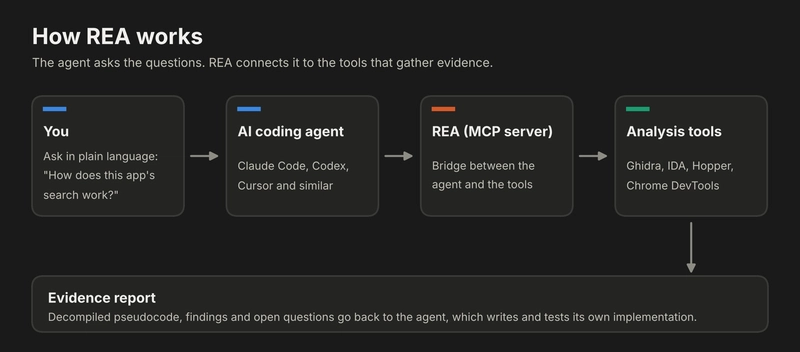
AI-assisted reverse engineering connects these tools with AI agents that can interpret instructions, perform analysis and explain their findings in natural language.
For example, a developer might ask an AI agent to investigate how a particular application handles search requests or identify suspicious behavior in a binary. The agent can help coordinate the analysis and summarize the evidence.
Projects such as "Reverse Engineer Anything (REA)" (https://github.com) illustrate the growing interest in connecting AI agents with established reverse engineering workflows. The underlying analysis tools are not entirely new. The significant change is making them easier to use through natural-language instructions and automated workflows.
However, AI-assisted analysis has limitations. Decompilation does not automatically recover the original source code, variable names or development history. Complex applications may contain undocumented behavior, external dependencies and edge cases that remain difficult to reproduce.
AI lowers the barrier to investigation. It does not eliminate the complexity of software engineering.
Why Is Reverse Engineering Becoming Cheaper?
Several developments are contributing to this change.
1. Natural-Language Interfaces
Previously, using advanced reverse engineering tools often required familiarity with their interfaces, analysis techniques and underlying concepts.
AI agents can translate high-level questions into sequences of technical tasks. This makes it easier for developers to explore unfamiliar applications without manually performing every step.
2. Automated Analysis
AI can assist with identifying patterns, explaining decompiled functions, organizing findings and suggesting areas for further investigation.
Instead of examining every function independently, an analyst can use AI to prioritize relevant sections and accelerate the investigation.
3. Integration With Existing Tools
AI agents can connect to established debugging, decompilation and browser inspection tools. This allows them to work with evidence collected from real software rather than relying entirely on assumptions generated from a prompt.
4. Lower Development Costs
When understanding an existing application's behavior becomes cheaper, building a compatible alternative may also become more accessible.
Developers can use observable behavior, public documentation and supported file formats to create independent implementations. The quality of these implementations still depends on testing, engineering decisions and the complexity of the original product.
Together, these changes are making reverse engineering more accessible to independent developers, security researchers and potentially malicious actors.
The Positive Side: Opportunities for Developers and Security Researchers
AI-assisted reverse engineering is not inherently harmful. In fact, it can provide significant benefits across several areas.
Faster Security Research
Security analysts often need to investigate suspicious executables, understand unfamiliar binaries and identify potentially dangerous behavior.
AI can help summarize functions, explain unfamiliar instructions and prioritize areas that deserve closer inspection. This can reduce the time needed to understand a program and help researchers focus on validating security findings.
AI-generated explanations still need verification. An incorrect interpretation of a function could lead an analyst to overlook a vulnerability or report a false positive.
Better Software Compatibility
Some software depends on undocumented formats, legacy interfaces or systems that are no longer actively maintained.
Reverse engineering can help developers understand these systems and build compatible alternatives. AI can make this process more accessible to small teams and independent contributors.
This is particularly valuable when the goal is interoperability, migration or long-term software preservation.
Reduced Vendor Lock-In
Businesses sometimes depend heavily on a single software provider because migrating to another platform is expensive or technically difficult.
If independent developers can build reliable alternatives more efficiently, organizations may gain more choices. Competition can encourage better pricing, improved portability and more transparent licensing practices.
However, an alternative that reproduces a few visible features is not necessarily a viable replacement for a mature enterprise application.
Preservation of Legacy Software
Older applications may become unusable because their original developers have disappeared, their services have shut down or their operating environments are no longer supported.
Reverse engineering can help preserve valuable functionality and make historical software accessible on modern systems.
AI may reduce the effort involved in understanding these systems, although legal restrictions and technical limitations still apply.
The Risks: What Happens When Everyone Can Analyze Software?
The same capabilities that benefit defenders can also benefit attackers.
1. Faster Vulnerability Discovery
Software vendors can no longer assume that compiled applications will remain difficult to analyze simply because their source code is private.
AI-assisted analysis may help researchers identify insecure logic, exposed secrets, weak validation and other implementation problems more quickly.
For defenders, this creates an opportunity to discover and fix weaknesses earlier. For attackers, it can reduce the time required to locate potential entry points.
Organizations should treat reverse engineering as a realistic possibility rather than relying on obscurity as a security strategy.
2. Easier Creation of Software Clones
An AI agent can help developers reproduce parts of an application's observable behavior, interface or file-format compatibility.
This may lead to more open-source alternatives and stronger competition. It can also create problems when a clone improperly reproduces protected code, proprietary assets or other intellectual property.
There is an important distinction between independently implementing similar functionality and copying protected implementation details. The legal outcome depends on the circumstances and applicable law.
3. Intellectual Property Disputes
AI-assisted development raises difficult questions about ownership, licensing and the boundaries of independent implementation.
For example:
- Can a developer recreate an application's functionality without infringing copyright?
- What happens when a model produces code that resembles a protected implementation?
- Does an existing software license restrict certain forms of analysis?
- Who is responsible when an AI-generated implementation violates third-party rights?
These questions do not have one universal answer. Copyright, trade secret protection, contractual restrictions and reverse engineering exceptions vary by jurisdiction.
Developers should review the applicable licenses and laws before analyzing or reproducing proprietary software.
4. Misplaced Confidence in AI-Generated Results
An AI-generated explanation can sound convincing while being technically incorrect.
Reverse engineering often involves incomplete information. A decompiler may produce confusing output, an agent may misunderstand control flow and a suggested implementation may fail under real-world conditions.
Every important finding should be validated through appropriate testing and independent analysis.
Automation can accelerate technical work, but it cannot replace evidence.
Does This Mean Software Development Is Becoming Obsolete?
No. It means the competitive advantages of software products are changing.
When recreating basic functionality becomes easier, simply having a collection of features may no longer be enough to distinguish a product from its competitors.
Consider what makes a mature application valuable:
- Reliability across different operating environments.
- Performance under real workloads.
- Accessibility and usability.
- Security and privacy protections.
- Compatibility with existing systems.
- Data integrity and recovery mechanisms.
- Customer support and ongoing maintenance.
- A trusted ecosystem of integrations and users.
A prototype can reproduce a screen or demonstrate a basic workflow in a short time. Building a dependable product requires much more.
For software developers, the opportunity is to spend less time on repetitive implementation and more time solving meaningful problems. The challenge is to ensure that AI-generated work meets the standards users expect from production software.
The value of engineering is not disappearing. It is shifting toward architecture, judgment, verification and the ability to deliver dependable systems.
How Developers Should Adapt
Developers can take several practical steps to prepare for this change.
1. Build Security Into the Architecture
Do not assume that compiled code or a private repository will prevent someone from understanding how an application works.
Keep sensitive credentials and critical secrets out of client-side code. Use server-side authorization, validate inputs and restrict access to sensitive operations.
Remember that moving logic to a server is not a complete security solution. APIs can still be observed and abused if authentication, authorization and rate limiting are weak.
2. Use AI for Defensive Analysis
Developers and security teams can use AI-assisted tools to investigate suspicious binaries, review application behavior and support authorized security testing.
Establish clear boundaries around which systems may be analyzed and how findings should be validated.
3. Define Rules for AI Coding Agents
When using an AI agent to reproduce or analyze software, specify which sources it may inspect and which sources are prohibited.
For independent implementations, document the permitted inputs, such as public documentation, published specifications and observable behavior. Keep records of design decisions and testing results.
These practices help teams maintain a clearer separation between independent development and unauthorized copying.
4. Test Beyond the Happy Path
A feature that works in one demonstration may fail with unusual inputs, large datasets, network interruptions or unexpected user behavior.
Use automated tests, security testing, compatibility checks and real-world validation before treating AI-generated implementations as production-ready.
5. Compete on More Than Features
Businesses should invest in the parts of their products that are difficult to reproduce through observation alone.
These may include proprietary datasets that are lawfully obtained, high-quality integrations, dependable operations, excellent support, strong security and a trusted customer relationship.
The goal should not be to make every feature impossible to copy. It should be to create a product that remains valuable even when alternatives exist.
The Legal and Ethical Boundary
AI-assisted reverse engineering does not automatically make an activity legal or illegal. The purpose of the analysis, the software involved, the applicable license and local law all matter.
Before analyzing third-party software, consider the following:
- Do you own the software or have authorization to examine it?
- Does the applicable license permit the intended activity?
- Are you accessing confidential information or bypassing technical protections?
- Could your implementation reproduce protected code or proprietary assets?
- Are you complying with relevant copyright, cybersecurity and trade secret laws?
Security research and interoperability can have legitimate purposes. Unauthorized access, theft of trade secrets and infringement remain serious concerns.
For professional work, obtain legal guidance when the boundaries are unclear. An AI agent performing the analysis does not remove the user's responsibility for the activity.
Conclusion: The Cost of Understanding Software Is Falling
AI-assisted reverse engineering represents a meaningful shift in software development and cybersecurity.
It can help researchers understand unfamiliar systems faster, make compatibility projects more accessible and encourage competition in markets dominated by established vendors. At the same time, it can accelerate vulnerability discovery by malicious actors, increase the risk of unauthorized cloning and create new intellectual property disputes.
The technology does not make every application easy to reproduce, nor does it make traditional engineering skills irrelevant. Instead, it changes how much effort is required to move from observing a system to understanding and reproducing parts of its behavior.
For developers, the practical response is clear: build secure systems, validate AI-generated results, respect software licenses and focus on the qualities that make products genuinely useful.
When software becomes easier to understand, the real advantage is no longer just knowing how to build it. It is knowing how to build it securely, reliably and responsibly.
Further Reading
- "What Happens When AI Makes Reverse Engineering Cheap — Maria Mendonca"
- "Ghidra — Software Reverse Engineering Framework"
- "OWASP Foundation — Application Security Resources"
This article is an independent analysis inspired by the source article linked above. It has been rewritten with additional explanations and practical recommendations rather than reproduced verbatim. Technical capabilities and legal considerations may evolve as AI tools and relevant regulations change.